Fu · 符籙
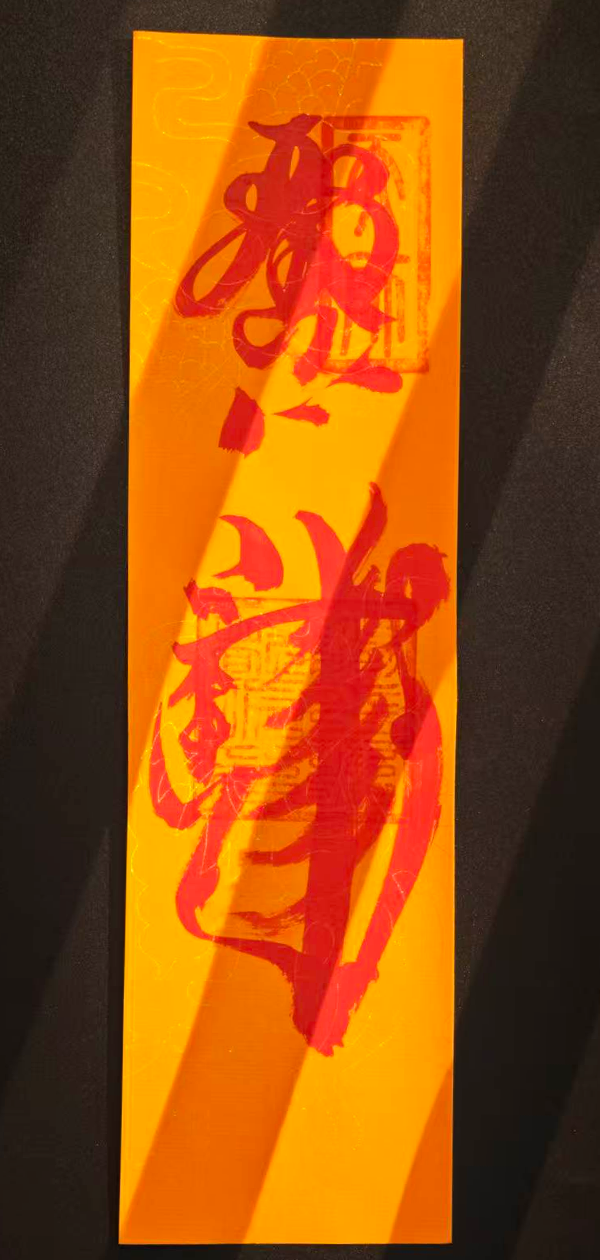
Written talismans bearing celestial seals, used to bless, protect, heal and harmonize a space or a person.
The Sacred Arts
Taoist ritual works with written signs, spoken words, hand gestures and patterned steps. Together these arts are believed to align human purpose with the energies of the cosmos — a technology of meaning, handled with care and reverence.
The Written and the Spoken
A fu talisman is a written charm, usually drawn in cinnabar ink on paper, wood or cloth. Its script is deliberately unusual — a sacred calligraphy of compressed characters, celestial symbols and seals, intelligible to the trained priest rather than to ordinary reading.
A zhou incantation is its spoken counterpart: rhythmic verses chanted to gather the mind, invoke a deity, or direct ritual energy. Neither art is meant as magic in the sensational sense. Both are disciplines of attention, given form through centuries of liturgical practice.
The Arts of Ritual
Written talismans bearing celestial seals, used to bless, protect, heal and harmonize a space or a person.
Sacred verses chanted in rhythm, to concentrate the mind and invite the presence of the divine.
Mudras — symbolic hand gestures that seal, focus and direct the flow of ritual energy.
Star paces: stepping the pattern of the Big Dipper, symbolically travelling through the heavens.
Anatomy of a Talisman
A talisman is typically arranged in three parts. At the top, three dots or circles invoke the Three Pure Ones. The middle carries the commanding script — the heart of the charm, naming the deity or the intended effect. The lower portion bears the seal of the priest or the celestial office that authorizes it.
The materials matter too: cinnabar red for its association with life and yang energy, yellow paper for the earth, and the priest's own breath and intent applied as the brush moves. The finished object is less a piece of writing than a record of a ritual act.
The Greater Context
Talismans belong to the wider world of zhai jiao — the ceremonies of fasting and offering performed in Taoist temples. These liturgies mark the seasons, petition for harmony, and renew the bond between the community, the deities and the natural order.
Viewed with respect, these arts reveal a striking idea: that the cosmos responds to attentive, intentional action, and that human beings can participate in that response. They are a language of relationship, not a instrument of control.
Held with reverence, these arts are a language of the sacred — tools of focus and intention.